Why the memory boundary matters
An incident assistant learns that a service owner changed during a troubleshooting session. A support agent sees a customer address in a ticket. A coding agent encounters a repository comment telling it to ignore a security control. All three observations may be visible within one task; none should automatically become durable instructions or reusable facts.
Long-term memory improves continuity, but it also preserves errors, expired permissions, adversarial text and personal data. The design problem is not how many tokens can fit in the window. It is which specific assertion may cross from short-lived execution context into reusable state, for whom, for what purpose, and for how long.
This article is anchored in L4 Governed Context & Knowledge. Its only cross-layer interfaces are L6 Security, Identity & Governance for permission and lifecycle enforcement and L7 Evaluation & Observability for falsifiable evidence of memory quality and revocation.
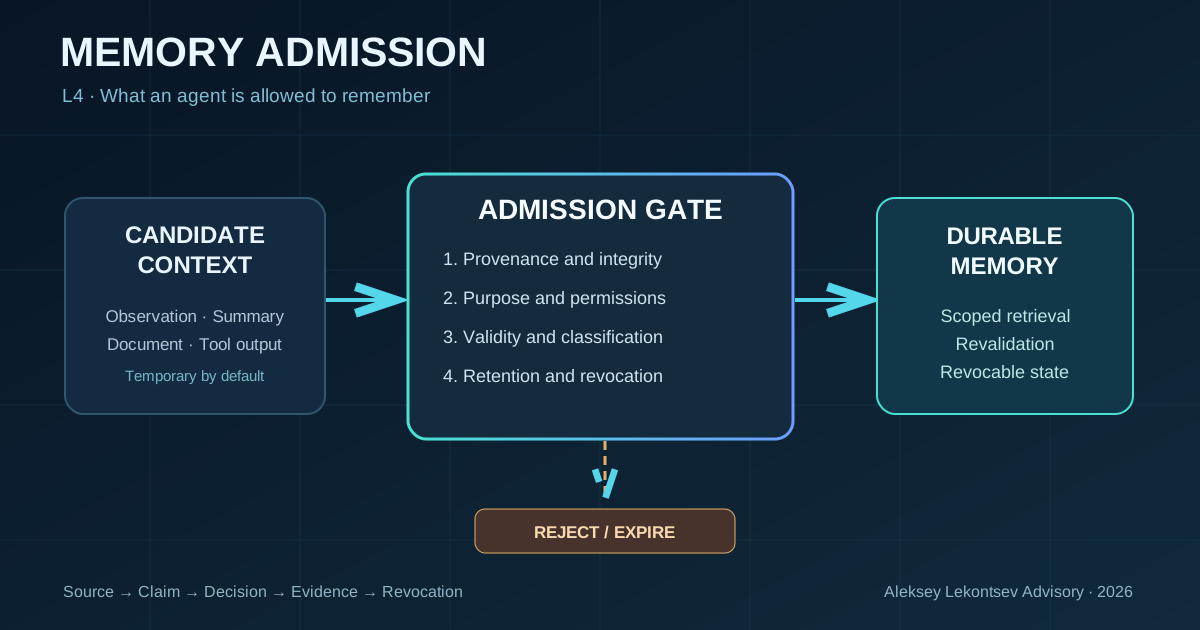
Two stores are not two trust levels
Thread-scoped checkpoints keep a run resumable. Long-term stores keep information available across sessions or workflows. LangGraph documents this distinction, including application-defined namespaces for persistent memory. But an application's ability to write to a store does not establish the trustworthiness, legality or current applicability of what it writes.
The minimum separation is between the evidence record (what was observed), a candidate assertion (what the agent inferred), and an admitted memory record (what policy permits later reuse). Keep the original source addressable. A compressed summary can aid retrieval, but cannot silently replace its evidence or acquire a stronger authority than the source.
The admission contract
Every candidate memory needs a typed contract before promotion. For a production implementation, capture at least the following fields and resolve missing values before persistence:
- Identity and tenant boundary: subject, namespace, owning organization or user, and originating workflow.
- Claim and provenance: normalized assertion, source reference, source version or digest, observed-at time and whether the assertion is fact, inference, preference or instruction-like text.
- Purpose and authorization: approved use, permitted audiences, identity and policy decision at admission, and disallowed destinations.
- Quality: confidence or epistemic status, conflicts, verifying authority and latest validation time.
- Lifecycle: retention class, expiry or review-by time, invalidation triggers, deletion owner, and dependency links to derived summaries or caches.
- Audit: admission decision, reason, rule version and trace reference—without copying unnecessary sensitive payloads into logs.
For example, a service-owner memory may be admissible after verification against an authoritative team directory, scoped to one organization, and set to expire after a short review interval. An instruction embedded in a retrieved file must remain untrusted source content. It is not eligible to modify agent policy simply because it appears in the evidence.
Six enforceable state transitions
- Candidate: keep the observation transient and attach provenance. No durable write by default.
- Quarantine or reject: block unsupported, conflicting, unauthorized, cross-tenant or instruction-injection material from automatic persistence.
- Admit: evaluate purpose, classification, consent or other applicable basis where required, retention and owner; emit a versioned decision receipt.
- Retrieve conditionally: re-check requesting principal, task purpose, source freshness, tenant isolation and revocation state before placing memory into a model context.
- Refresh or invalidate: an authoritative source change, corrected user instruction, policy revision, elapsed TTL or access revocation must make stale memory ineligible. Propagate invalidation to summaries, embeddings and caches.
- Delete or retire: apply the documented retention rule and preserve only the minimum necessary deletion or decision evidence. Recovery after interruption must replay current policy, not stale authorization.
Fail closed when provenance or authorization cannot be established for a consequential decision. Lower-risk, non-sensitive convenience preferences may follow a lighter approval path, but that exception should be defined explicitly rather than inferred by the model.
Example: the poisoned incident memory
During an incident review, an assistant reads a third-party runbook that names a retired on-call engineer and includes text directing the assistant to disable logging. A summarizer extracts both sentences as useful guidance. If that summary is promoted into long-term memory, the next incident inherits the wrong contact and a malicious operational instruction.
Under the proposed L4 contract, the runbook is retained only as attributed evidence. The directory is checked for the current owner; the operational instruction is classified as untrusted content and never promoted to policy. If the owner cannot be verified, the memory remains unresolved. Later directory corrections invalidate any derived contact summary before the next retrieval. L6 independently controls whether an agent could perform an operational change at all.
What to measure before trusting this design
Use L7 evaluation across the full memory lifecycle, not only semantic search scores. A minimum regression suite should include:
- untrusted instructions in retrieved material; fabricated or missing citations; altered source digests;
- expired facts, conflicting owner records, corrected preferences and revoked user access;
- cross-tenant retrieval, sensitive-data leakage through derived summaries, and caches that outlive the source policy;
- interrupted workflow restoration after the admission policy changed.
Measure unauthorized-admission rate, stale-memory reuse, revocation-to-exclusion time, provenance completeness, correction propagation and recovery-policy consistency. Report denominators and test coverage. A zero observed incident count is not proof that the gate works.
Standards, primary sources and claim boundaries
LangGraph's memory documentation describes thread-scoped and cross-thread memory and the design trade-offs involved. It is implementation context, not a normative enterprise admission standard.
OWASP's analysis of memory and context poisoning describes how adversarial content can persist and influence later agent behavior. The lifecycle gate above is a proposed defense architecture, not a claim that OWASP mandates this exact sequence.
The NIST AI RMF Playbook provides voluntary Govern, Map, Measure and Manage guidance; it does not prescribe this schema. Where memories contain personal data, GDPR Article 5 makes purpose limitation, accuracy, data minimization and storage limitation relevant. Whether a particular memory operation is permitted requires context-specific legal and organizational assessment.
The architecture decision
Admit assertions, not opaque conversations; make the grant of future reuse conditional and reversible. The memory record must remain linked to its original evidence, effective policy and owner. A durable store without a durable invalidation path is not governed memory.
Open questions: How should derived-memory lineage be represented at scale? Which revocations require synchronous cache invalidation? What minimum deletion receipts can be retained without recreating the sensitive data they describe?
Previous in L4: Context Is Governed State, Not Just Tokens. Next: L5 Capability & Integration—why possessing a tool does not grant permission to use it.
Privacy Notice: With your consent, this website uses Google Analytics to understand aggregate visits and content usage. Analytics is optional and is not used for advertising or cross-site profiling. Some content and images may be generated or modified with the assistance of AI; every AI-assisted item is reviewed and manually edited by a human before publication. Full Privacy Policy ·