Guardrails belong around the system, not just around the answer.
Production AI can fail through identity, permissions, retrieval, model behaviour, tool execution, data handling, cost, monitoring or human decision rights. A layered guardrail architecture places the control where the risk is created and keeps policy authority outside the model itself.
Guardrail decisions before production
Map each material AI risk to the point in the lifecycle where it can actually be prevented, constrained, detected or escalated.
System ownerBefore productionSeparate policy ownership from technical enforcement. The agent may execute a policy decision; it should not invent the policy state.
Governance ownerBefore automationUse deterministic controls for mechanically testable requirements and reserve model judgement for semantic ambiguity.
Architecture ownerDuring design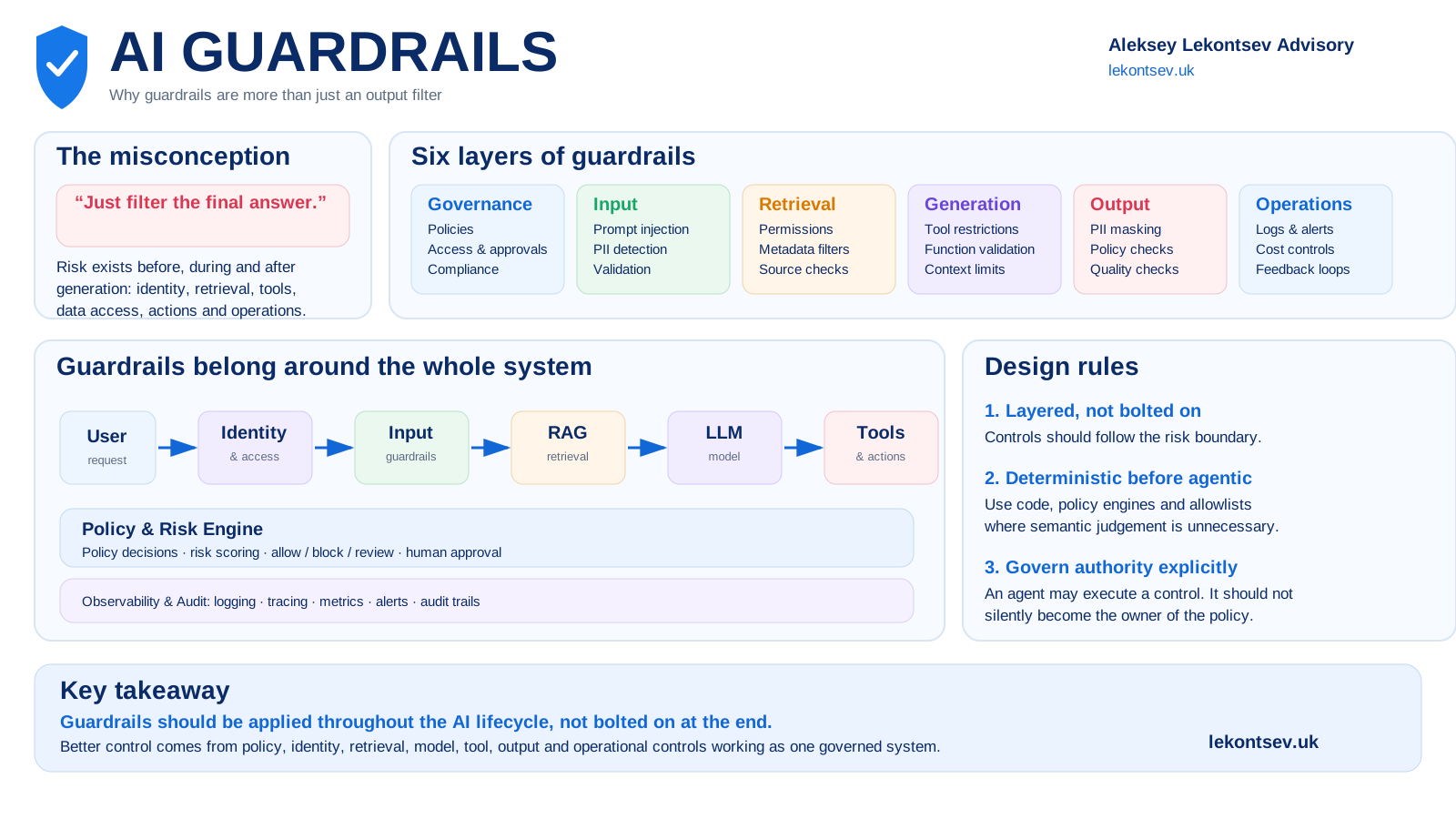
The output-filter misconception
The easiest guardrail to understand is the one placed immediately before a response reaches the user. Check the generated text for prohibited content, sensitive data, unsupported claims or policy violations, then allow, modify or block it. That pattern is useful, but it covers only one surface of the system.
Consider an agent that retrieves a confidential document it should never have seen, calls a production tool with excessive privileges, spends ten times the expected budget, or takes an irreversible action based on stale context. A perfect final text filter does not undo any of those events.
The practical rule is simple: place the control where the risk is created. Output validation is one layer in a larger architecture.
Six layers of guardrails
1. Governance guardrails
Governance defines what the system is allowed to do before any prompt is processed. This includes policy, regulatory applicability, role definitions, approval thresholds, model and tool allowlists, exception handling, risk acceptance and lifecycle reassessment.
The critical distinction is between policy state and enforcement mechanism. A model or orchestration framework may evaluate or execute a rule, but the authority behind that rule should come from an explicitly governed source.
2. Input guardrails
Input controls protect the system before untrusted content reaches the model or workflow. Typical controls include prompt-injection detection, content validation, PII detection, file-type restrictions, request-size limits and context sanitisation. Identity and access checks usually belong even earlier.
3. Retrieval guardrails
RAG systems introduce a separate trust boundary. The question is not only whether a document is relevant, but whether the requester and the agent are authorised to retrieve it, whether the source is permitted, whether metadata is trustworthy, and whether sensitive content can cross the current data boundary.
Retrieval therefore needs permission-aware filtering, provenance, source validation and data-classification rules. Relevance alone is not an access-control model.
4. Generation and tool guardrails
Generation-time controls constrain how the model can behave: system instructions, context boundaries, function schemas, model selection, token limits and tool eligibility. For agents, tool control is often more important than text moderation because tool calls create external effects.
Use allowlists, least privilege, parameter validation, execution sandboxes, rate limits, budget controls and human approval for consequential actions. An agent that can reason broadly should still act narrowly.
5. Output guardrails
Output controls remain necessary. They can detect sensitive data, policy violations, malformed structured output, unsupported claims, unsafe content and required disclosures. In higher-risk systems, output evaluation may combine deterministic checks with model-based review and evidence comparison.
6. Operations guardrails
Production control continues after a response is returned. Logging, traces, metrics, anomaly detection, cost monitoring, alerts, incident handling, evaluation results and feedback loops determine whether the organisation can see drift and intervene before small problems become systemic.
This is also where apparently safe systems become unsafe over time. Models change, tools change, prompts change, data changes and attackers adapt. Guardrails are operational controls, not a one-time configuration exercise.
A policy and risk plane above the workflow
One useful architecture is to treat policy, risk decisions and human authority as a control plane that spans the workflow rather than as another node inside it. Identity, retrieval, model execution, tools and outputs can all ask the same governed layer for decisions such as allow, block, redact, escalate or require approval.
This pattern is stronger than embedding unrelated guardrails independently in every component because it preserves decision consistency and makes policy provenance visible. It also supports replacement: models and frameworks can change while the control intent remains stable.
Deterministic before agentic
Not every guardrail should be another LLM call. If a requirement can be evaluated reliably with code, schemas, policy engines, access-control lists, linters, regular expressions, static analysis or cryptographic checks, those mechanisms are usually cheaper, faster and more predictable.
Cloudflare describes the same engineering direction in its standards-enforcement architecture: mechanically enforceable requirements can move into deterministic tooling, while AI reviewers are used where semantic judgement adds value. Their standards lifecycle also separates approved guidance from rules that are mature enough to block work. That is an important governance pattern for AI systems as well.
Common failure patterns
- Output-only safety: controls begin after retrieval, generation and tool execution have already happened.
- Framework-owned policy: organisational rules exist only as settings inside the current AI product.
- Relevance without authorisation: RAG retrieves a useful document the requester should not access.
- Unlimited tools: broad reasoning capability is paired with broad execution privileges.
- Model where code is enough: nondeterministic judgement replaces a simple enforceable invariant.
- No operational feedback: the system passes pre-production tests but drift, cost and incidents are not monitored.
- Nominal human oversight: a human approval step exists, but the person lacks information, authority or time to make a meaningful decision.
A practical design sequence
for each material AI risk:
  locate where the risk is introduced
  define the control objective
  prefer deterministic enforcement when sufficient
  define policy owner and decision authority
  define allow / block / review / escalate behaviour
  capture evidence and audit requirements
  test representative failure paths
  monitor effectiveness in production
  reassess when model, data, tool or policy changes
Guardrails do not replace system design
A guardrail is not a substitute for a sound architecture. A badly designed system with enough filters remains a badly designed system. The stronger pattern is to reduce unnecessary privilege and complexity first, then add controls around the remaining risk.
This is why "more guardrails" is not automatically better. Every control adds latency, cost, maintenance effort and potential false positives. The objective is not maximum restriction. It is controlled capability: enough freedom for the system to create value, with explicit boundaries around what it may know, decide and do.
Claim boundaries
- Established: defence in depth, least privilege, policy enforcement and lifecycle monitoring are mature security principles.
- Supported synthesis: applying those principles at governance, input, retrieval, generation, tool, output and operational layers produces a more complete AI control architecture than output moderation alone.
- Architecture recommendation: keep policy authority and evidence outside replaceable model/framework implementations.
- Not claimed: that guardrails eliminate hallucinations, remove the need for secure architecture, or make every AI use case safe.