What actually changed in the catalog
Five research or control changes were merged into the Harness Collection during this reporting window: AWS AI-DLC assessment (#560), AgentScope assessment (#556), RAGFlow retrieval assessment (#553), prompt-cache diagnostics (#549) and repository-wide Skill/MCP admission gate (#547). Merge evidence establishes repository changes, not runtime rollout, external evaluation, or customer adoption. The 31 October–1 November overlap with the previous Weekly is not counted as a second deployment.
1. Delivery workflows need authority outside the workflow engine
Primary source: AWS Labs AI-DLC Workflows describes a structured, multi-phase AI-assisted delivery process with source-managed stages, project state and explicit human decision points. Catalog change: PR #560, merged 6 November, added an SDLC reference and an assurance crosswalk.
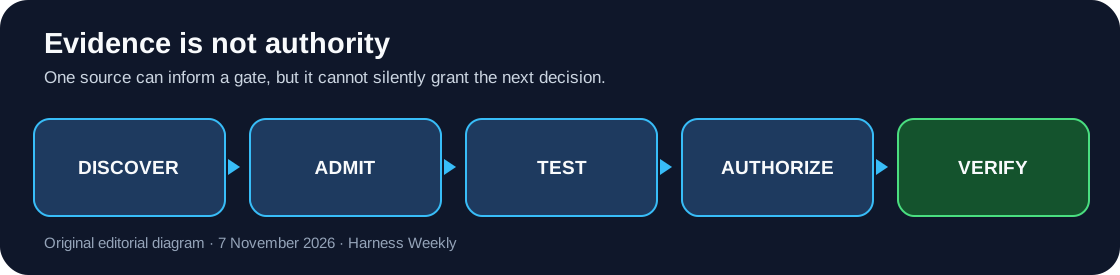
Architecture decision: treat workflow stages and self-reported approvals as coordination evidence. Consequential changes still require independently enforced authorization, artifact identity, negative tests and target-side deployment verification. Limit: upstream descriptions and a catalog assessment are not an independently reproduced security evaluation; default guard behavior must be verified for the selected workflow profile.
2. Agent runtime releases require cancellation and isolation regression tests
Primary source: the AgentScope v2.0.11 release, published on 27 October, documents fixes including cancellation before concurrent tool execution and provider-stream cleanup. The upstream release date is outside this brief's window; its catalog reassessment occurred inside the window through PR #556, merged 6 November.
Architecture decision: a release note is a candidate reason to retest, not operating assurance. The catalog now describes ten synthetic gates addressing authorization, tenant isolation, cancellation, retries, idempotency, tracing, privacy and tool boundaries. Limit: those test definitions do not prove the ten tests passed against a deployed customer environment.
3. Retrieval infrastructure can compile evidence without granting source authority
Primary source: InfiniFlow RAGFlow documents retrieval, document processing and agent-facing knowledge capabilities. Catalog change: PR #553, merged 6 November, added a pinned release-candidate reference, source provenance and a proposed evaluation plan.
Architecture decision: measure source-ACL enforcement, cross-tenant isolation, citation fidelity, false evidence sufficiency, latency and reproducibility against simpler retrieval baselines. A retrieved document may support a factual claim but must not become an instruction or privilege grant. Limit: the catalog entry is a relevance assessment only. No production ingestion, benchmark reproduction or safe migration has been established.
4. Cache savings cannot be inferred from a cache-hit flag alone
Primary source: Anthropic's prompt caching documentation explains prefix matching, explicit cache controls, time limits and usage accounting. Catalog change: PR #549, merged 6 November, extended provider-aware FinOps diagnostics rather than creating a duplicate tool.
Architecture decision: compare matched workloads with stable and changing prefixes, record cache writes and reads, model versions, total cost and output quality, and test tenant-scoped isolation. Limit: documentation describes supported provider behavior; no local cost reduction, cross-provider equivalence or privacy guarantee has been measured.
5. A safe-looking skill file does not establish a safe repository
Primary source: the Agent Skills format specification defines a mandatory SKILL.md plus optional scripts, references and assets. Those surrounding files can change the supply-chain risk. Harness change: PR #547, merged 6 November, introduced an offline, whole-repository pre-admission gate with pinned-revision checks and evidence receipts.
Architecture decision: inspect a complete pinned worktree, quarantine unreviewed executable or archive surfaces, retain provenance and require separate evaluation and human approval before installing or invoking a capability. Limit: static checks and synthetic unit tests neither establish runtime safety nor authorize a production installation.
Other verified work and boundaries
PR #554 (5 November) added a candidate-only Vendor AI assurance contract and synthetic tests; PR #561 (6 November) classified separate AI-security and SaaS-access-governance products; PR #552 (6 November) documented a New Outlook token-exposure defensive crosswalk. These are repository changes, not claims of vendor compliance, live tenant controls or a newly released Harness architecture version.
Decision checklist
- What exact upstream version or document supports the capability claim?
- Which repository PR and CI result support the claim that the catalog changed?
- What independent tests and permission checks remain necessary before use?
- How will observed deployment, operating outcomes and residual risk be verified?
- Which tenant, retention and cost assumptions could invalidate the decision?
Method and limitations: five first-party sources were read separately from the merged collection changes. All design recommendations are editorial inferences, not requirements imposed by those projects. No tool, cache, retrieval server, skill or vendor assurance workflow is claimed as deployed. The 7 November weekly receipt, dated analytics baselines, customer benchmarks and production adoption evidence remain unavailable in the reviewed artifacts.
For the overall system context, see the L0–L8 architecture map and end-to-end example, then the governed invocation controls.
Privacy Notice: With your consent, this website uses Google Analytics to understand aggregate visits and content usage. Analytics is optional and is not used for advertising or cross-site profiling. Some content and images may be generated or modified with the assistance of AI; every AI-assisted item is reviewed and manually edited by a human before publication. Full Privacy Policy ·